There was theatre (Griffith), poetry (Murnau), painting (Rosselini), dance (Eisenstein), music (Renoir), Hencefort there is cinema. And the cinema is Nicholas Ray.
--Jean-Luc Godard on Bitter Victory (1957)
We don’t talk enough these days about Nicholas Ray.
I can’t recall watching any of his films in class, which is a shame. Ray’s films are startlingly modern, his innovations, while subtler, are as radical as those of
Citizen Kane and less schematic. He is perhaps, along with Howard Hawks
[1], the greatest director America ever produced.
With Ray, American narrative cinema for the first time breaks free from the nineteenth century theatre in a way that it hadn’t with any other American director except for Buster Keaton. Ray's films such as
Johnny Guitar and
In A Lonely Place, are at once unsentimental and brutally romantic, filled with a cinematic exuberance while fatalistic about existence. He is equally at home in both adolescent and middle-aged angst. No wonder the
nouvelle vaguers idolized him.
On Dangerous Ground is a picture that speaks volumes within its frames. The bleary opening shots of New York City over a Bernard Herrmann score anticipate
Taxi Driver by nearly a quarter century. They signify Robert Ryan’s Jim Wilson’s alienation from both his environment and work that have degraded his soul, setting him up to be reborn in the jagged whiteness of wintry Colorado playing upstate New York.
[2] Ray elicits the tenderness within Ryan’s ferocity with the same delicacy with which Eric Rohmer elicited the kindness in Trintignant’s
reticence, in
My Night At Maud's.
Ground starts with a traditional Robert Ryan role, introducing his Jim examining mug shots alone in his spartan apartment. His calm exterior masking an inveterate rage at the city, criminals, and his peers. This is a man who is incapable of compartmentalizing. This is a man who has internalized the violence that surrounds him. What makes the story unique though, is that the story of is less about redemption or growth, but about healing.
Initially, the film’s narrative structure feels unwieldy. The film's first act is all character exploration. We follow Jim as he does his job, and come to understand just how deeply alienated he is. Then the film takes him to the snowy north. Ray uses this time to set up elements in both the
mise-en-scène and the action that will be contrasted by the
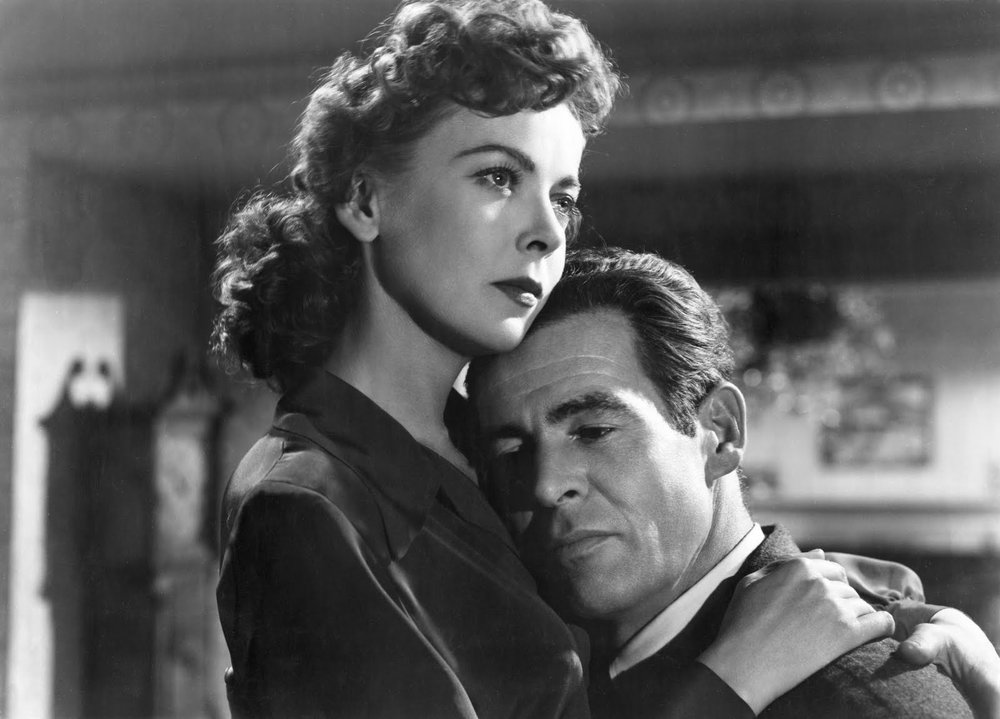
legato second section. This is especially apparent in two contrasting scenes of interrogation. The first in which Jim uses a mask of kindness to elicit information from a prostitute about the location of her abusive boyfriend, and in the second where the mask becomes a reality in the alien space of Ida Lupino’s blind Mary Malden's living room.
[3]
As he recognizes her blindness, his eyes open to the moral gray area he has entered. What begins as an interrogation slowly turns into a narrative of mutual self-examination. The camera traces the actors’ movements throughout the living room. While this stifling urban "city" is portrayed in stark perpendicular lines, Mary's living room is filled with broken rococo surfaces and talismanic objects (the tree that grows in the center of the living room, a piece of wood, a small bust and a hanging plant). Ray portrays Mary's space as tactile rather than visual
[4] and has Jim adapt himself to this alien situation. His Manichaean perspective ebbs away and rediscovers his empathy as he adjusts to the delicate asymmetry of a new space.
Once removed from the tyrannically rigid city and placed in Mary's openly free-flowing home, even if for a few days, he begins to transform and heal.
Ironically, in this new space, the story becomes unsettled at the very time it becomes spatially centered, as it boils itself down to two people in a room talking. The exchange ushers in compassion for Mary, making him a more insightful detective and a better person.
Ray’s unique sensitivity to environment is what elevates his work to greatness. Much is made of his architectural background (he was a pupil of Frank Lloyd Wright). But this understanding is much broader and totally filmic. His sensitivity to space and character are not two separate facets of his genius, but the same. He sees so clearly how environments can both express and transform characters as well as be transformed by them. Once seen who can forget James Mason on the stairs, the way James Dean, Natalie Wood, and Sal Mineo create a makeshift familial space in a decaying mansion, or Humphrey Bogart and Gloria Grahame forming a bond across the Hollywood courtyard before they even speak to each other. Ray’s craft goes deeper than a mastery of mise-en-scène. The inner space of Ray’s characters is defined or expressed by their environs. They are their environs.
On Dangerous Ground isn’t Ray’s greatest work but it is representative and therefore utterly brilliant.
[1] Both of them Midwesterners, natch; so I guess that’s a win for flyover country.
[2] Calling to mind the nothing so much as the opening of Larisa Shepitko’s
The Ascent.
[3] I want to note what a marvelously perverse choice it is to cast Lupino, so known for the expressivity of her wide eyes as a blind woman. Her airily stylized performance creates a special tension when paired with Ryan’s brusque naturalism.
[4] Note the way that Lupino touches the hanging plant when she enters the room.